
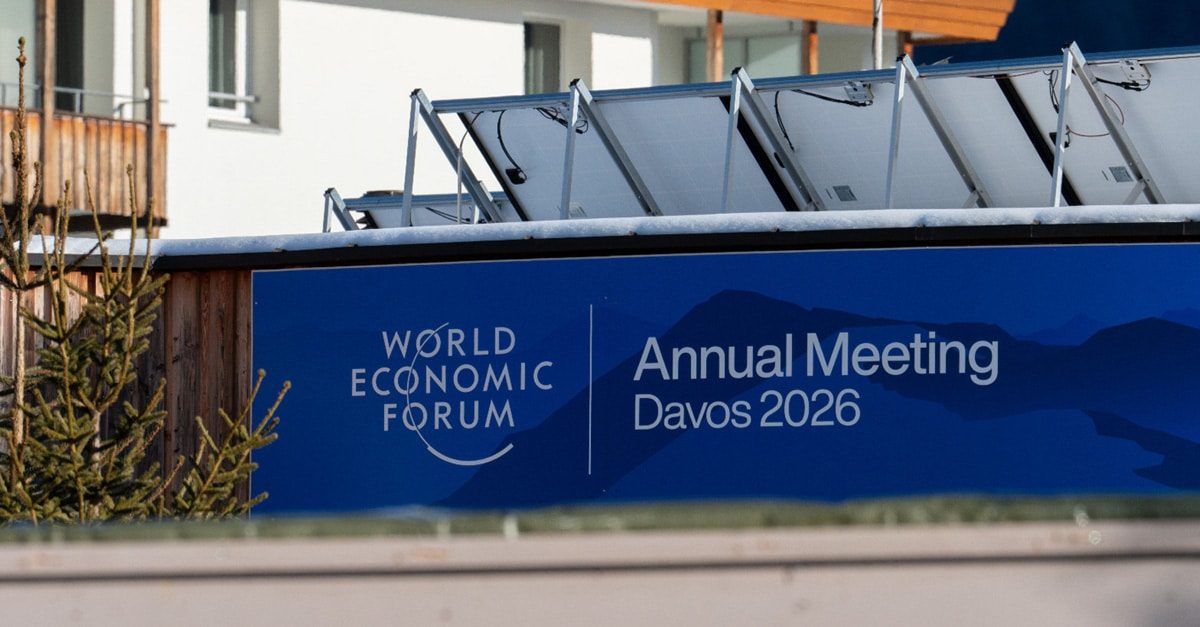
Technology sat at the centre of the Davos agenda, but the emphasis shifted from what new tools could do to how existing institutions can realistically deploy them. For those operating in digital wealth management, this shift had direct implications. Not because Davos suddenly turned its attention to private banking or advisory platforms, but because the assumptions that underpin long-term wealth creation were being reassessed in real time. Discussions of artificial intelligence, geopolitics, energy systems and 21st-century leadership were linked by a common concern: how much change institutions can absorb without eroding trust. Technology was treated less as a standalone driver of value and more as something embedded in economic, political and organisational realities.
Taken together, these discussions formed a consistent pattern across the week, surfacing in different sessions and settings but pointing in the same direction. This article draws on political panels and high-level executive sessions, reports launched during the week and repeated off-stage conversations. It traces that recurring pattern and examines why these ideas surfaced again and again, and why they matter for the stewardship of wealth in a digitally mediated world.
Artificial intelligence and the end of technological innocence
Artificial intelligence was omnipresent in Davos. During a series of sessions hosted by professional services firms and technology groups, the focus shifted away from model capability towards outcomes. One figure, cited repeatedly across panels and private CEO roundtables, framed the debate with uncomfortable clarity. More than half of large organisations globally report that their AI investments have yet to deliver measurable financial returns.
This observation was articulated most explicitly during discussions led by PwC, whose global leadership used the statistic to underline a broader point: AI is no longer constrained by technology, but by institutional readiness. In other words, the bottleneck has moved from engineering to governance.
That distinction resonated strongly in wealth management conversations. Several executives from private banks and digital platforms noted that AI experimentation had outpaced clarity on accountability. Algorithms are increasingly used to support portfolio construction, risk profiling and client segmentation, yet responsibility for outcomes often remains diffuse. Regulators attending these sessions were blunt. When AI influences advice, explainability is not optional.
The implication for digital wealth management is structural. Unlike consumer technology, wealth platforms operate within a fiduciary framework. Decisions are not judged solely on performance, but on process. In Davos, multiple speakers stressed that clients may accept complexity, but they do not accept opacity when markets turn or outcomes disappoint.
This was not framed as an argument against AI. It was framed as an argument for maturity. Institutions that treat AI as a layer on top of existing processes are increasingly exposed. Those that integrate it into clearly governed decision systems are beginning to differentiate themselves.
Productivity myths and the reality of long-term value
Another theme that surfaced repeatedly was the reassessment of productivity. In a panel on economic growth and labour markets, IMF representatives warned that while AI will reshape productivity over time, short-term gains are likely to be uneven and disruptive. That caution was echoed in private-sector sessions focused on implementation rather than theory.
For wealth management, this matters because the industry’s productivity gains rarely manifest as immediate cost reductions. Several executives noted that AI’s real contribution lies in decision quality rather than speed. Better risk monitoring. More consistent advice. Faster response during periods of market stress.
These improvements are difficult to quantify, yet they reinforce long-term client retention. In Davos, this tension prompted a broader discussion about investment horizons. Firms that evaluate AI through quarterly metrics risk underinvesting in foundational capabilities that only pay off over years.
Some participants framed AI not as a profit engine, but as a stabilising force. Used well, it can reduce operational error and behavioural bias. Used poorly, it amplifies them. That distinction, several noted, is now visible to capital.
Data governance as a wealth issue, not an IT problem
If AI was the headline technology at Davos, data governance was its foundation. During multiple sessions on digital trust and cybersecurity, speakers returned to the same conclusion: data quality and ownership determine outcomes far more reliably than model sophistication.
For digital wealth management, the relevance is immediate. Client data spans jurisdictions, regulatory categories and behavioural signals. Fragmentation remains endemic. When data ownership is unclear, AI systems inherit those fractures, producing recommendations that appear coherent but rest on incomplete information.
Several European regulators speaking on panels about digital finance argued that data governance must be elevated to board-level oversight. This is not merely about compliance. It is about strategic control. Institutions that cannot map how data flows through their systems are unlikely to maintain credibility as digital advice becomes more autonomous.
In Davos, this argument was tied directly to trust. Wealth management, more than most industries, depends on confidence that systems behave predictably under stress. Poor data governance undermines that confidence.
Resilience, geopolitics and the reordering of cooperation
Beyond technology, the most consequential discussions in Davos revolved around geopolitics and resilience. The Global Cooperation Barometer 2026, presented during the week, showed a clear trend. Global cooperation has narrowed in breadth, but deepened among aligned regions. Universal frameworks are giving way to selective alliances.
This might have direct implications for digital wealth management. Cross-border platforms must navigate diverging data localisation rules, regulatory expectations and political sensitivities. Several speakers from multinational financial institutions noted that the assumption of a single global operating model is no longer realistic. Instead, resilience is becoming synonymous with optionality. The ability to adapt systems to regional requirements without fragmenting the client experience is increasingly valued. Over-optimised platforms may be efficient, but they are also brittle. Davos’ discussions suggested that institutions are beginning to accept some inefficiency in exchange for robustness.
For private clients, this matters in moments of stress. Access to assets, continuity of service and clarity of communication are all affected by how well systems handle fragmentation. Davos made clear that geopolitical risk is no longer a tail risk. It is embedded in operational design.
Europe’s competitiveness and the credibility premium
Europe featured prominently in Davos debates about competitiveness. In sessions focused on regional growth, policymakers and business leaders acknowledged that while Europe excels at regulation, it struggles with scale. Capital markets depth and digital infrastructure were recurring concerns.
Yet there was also a counterargument, articulated by several European participants. In a world where trust in institutions is fragile, regulatory credibility is an asset. For wealth management, particularly digital platforms serving high-net-worth clients, this credibility underpins long-term relationships. The challenge is alignment. Regulatory rigour must be matched with sufficient capital and execution capability. Davos’ conversations hinted at consolidation and partnerships as likely responses, particularly among European wealth platforms seeking to scale without compromising governance.
Energy transition as a macro-wealth variable
Energy discussions in Davos were notably pragmatic. Panels on energy security reframed the transition away from pure climate ambition towards financial stability. Energy price volatility, speakers noted, feeds directly into inflation, currency movements and asset valuations.
For wealth managers, this reframing is significant. Energy transition assets are no longer niche thematic investments. They are macroeconomic variables. Capital allocation is becoming more selective, with a clear preference for projects that demonstrate resilience and integration into broader systems. The message from Davos was consistent with the broader mood. Technology, whether digital or physical, must justify itself within institutional and macroeconomic constraints.
Leadership in an age of constraint
Leadership conversations at Davos were understated. Executives spoke less about vision and more about execution. What distinguished credible leaders, according to several speakers, was not ambition but clarity. The ability to make decisions under uncertainty. To communicate limits as well as opportunities. To deploy technology without eroding institutional trust.
For digital wealth management, this leadership model aligns closely with client expectations. Wealth clients value continuity over novelty. They want assurance that technology is serving their interests, not showcasing innovation for its own sake.
What to remember from Davos 2026
For those who did not attend, the essential message from Davos 2026 is not hidden in any single panel or keynote. It lies in the convergence of conversations across technology, geopolitics and capital. This was a Davos that quietly acknowledged limits. Limits to acceleration. Limits to frictionless globalisation. Limits to technological optimism detached from governance. For digital wealth management, the implications are clear. Technology remains indispensable, but it is no longer self-justifying. Its value depends on how well it is governed, integrated and trusted over time. Those who succeed will not be those who adopt technology first, but those who align it most carefully with the long-term realities of wealth stewardship. That, more than any headline or declaration, was the real technology debrief from Davos in 2026.
Technology Takeaways from WEF Davos 2026
Technology is no longer self-justifying
Across Davos, AI, data infrastructure and digital platforms were discussed as institutional choices rather than neutral tools. Value was linked to governance, accountability and explainability, not speed.
Resilience is shaping system design
Technology discussions reflected acceptance that volatility and fragmentation are permanent conditions. Systems designed to function under stress were favoured over those optimised for efficiency or scale alone.
Standards matter more than reach
Global technology cooperation is narrowing but becoming more operational. Regional alignment on standards and data governance was seen as more realistic than universal frameworks.
Regulation is part of the technology stack
European debates highlighted that regulation is increasingly treated as an enabling layer for trust rather than an external constraint. Transparency and consumer protection are now integral to how technology platforms are evaluated.
Digital and energy infrastructure are strategic assets
Digital and energy infrastructure were discussed as strategic assets rather than background utilities. Reliability, security and interoperability are now central to technology credibility.
Technology leadership is about risk control
Technology leadership was framed as a governance task. Execution discipline and risk awareness were valued more than vision or disruption narratives.
Altoo Insights has prepared a dedicated Davos special exploring what the Forum’s agenda means for the work of family offices and the families they serve.
This article draws on official press materials, agenda notes, and public information published on wef.com.


